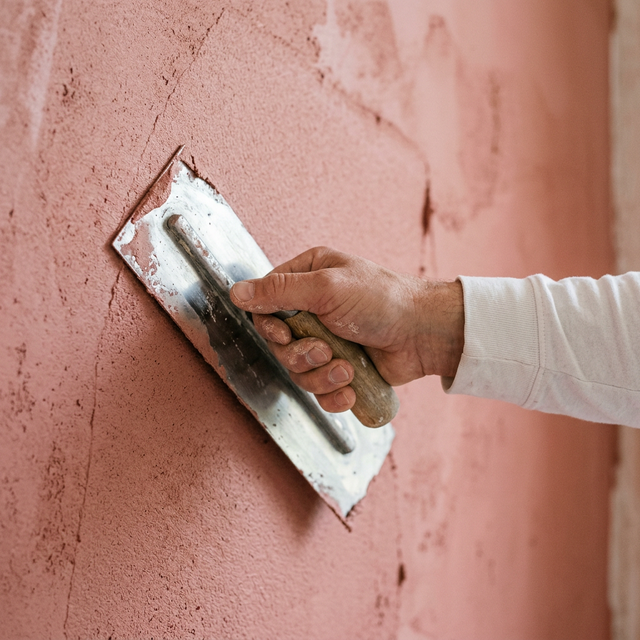
Hand-applied mineral lime plaster for feature walls and architectural surfaces — priced transparently at S$12.80 per square foot, prepared properly, and covered by a 36-month workmanship warranty. This page explains what lime plaster actually is, what it costs down to the arithmetic, and — just as honestly — where it does not belong.
Lime plaster is one of the oldest building finishes on earth: slaked lime and mineral aggregate, applied to the wall in successive layers with a trowel, then compressed and burnished by hand. It does not dry the way paint dries. It cures — slowly absorbing carbon dioxide from the air and converting back into calcium carbonate. In a real sense, the finished wall is a thin layer of reconstituted limestone. That is why we call our lime plaster the Living Stone wall: it has depth, tactility, and a response to light that a flat painted surface cannot imitate, and it ages with patina rather than wearing out.
The term gets muddied in the Singapore market, so three distinctions are worth making. Limewash (lime paint) is lime in liquid form — a breathable mineral wash with soft, cloud-like tonal movement, but essentially flat to the touch. It is a beautiful finish, and we apply it too — see our guide to the limewash feature wall in Singapore — but it is not plaster. Lime plaster is the full-bodied material: physical thickness, trowel movement, real texture you can run a hand across.
Then there are the imitations. Much of what is sold locally as "textured paint," "Venetian effect," or "plaster-look" coating is acrylic — a synthetic resin engineered to mimic the look of mineral plaster in a photograph. On the wall, the differences are structural: acrylic forms a plastic film that seals the wall, carries VOCs, and flattens under raking light. Lime is mineral through its full depth. The distinction matters most in exactly one place: a tropical climate.
The Tropical Argument
A Singapore wall lives under constant moisture load — from air that sits at 80% relative humidity, from the concrete behind it, and from the nightly air-conditioning cycle that condenses vapour inside the wall itself. Conventional acrylic paint responds by sealing the wall in plastic, which is why the default finish here peels, bubbles, and grows mould behind the wardrobe.
Lime plaster does the opposite. It is vapour-permeable — the wall breathes, releasing humidity instead of trapping it. Cured lime is naturally high-pH, an environment mould cannot colonise, so the wall resists mould without a single biocide added. It is zero-VOC, with no synthetic resins to off-gas into a bedroom. And because it cures by absorbing CO₂, the surface keeps hardening for years after application.
In this climate, the mineral finish is not the fragile, precious choice. Properly applied to a properly prepared substrate, it is the durable one.
Each plaster type is selected based on wall condition and desired texture.
A smooth mineral plaster with subtle movement and refined transitions.
Incorporates fine aggregates to introduce visible depth and texture.
A coarser blend designed for pronounced texture and character. Best for feature walls where raw materiality is the intent.
A refined finish with subtle movement and soft transitions.
Organic trowel marks that emphasise the handcrafted nature of the surface.
More pronounced texture inspired by traditional stone and masonry.
Every pattern is available across our colour library — tones like Kinta, Rajang, Monsoon, Strait, and Kapur, drawn from the rivers, weather, and stone of this region. Browse the full range on the colours page.
Transparent Pricing
Most lime plaster pricing in Singapore is quotation-only: you hand over your contact details, wait, and receive a number you cannot decompose. We publish ours. Wall area × S$12.80, plus the preparation rate that matches your property. That is the whole formula.
New BTO (bare): Micro-Skim + MineralLight prep — +S$1.50/sqft
Resale / occupied: Full Level 5 Resurface (strip acrylic, skim to mineral) — +S$4.80/sqft
CCR / luxury: Structural Mesh + Skim (anti-crack mesh, premium skim) — +S$5.50/sqft
A typical living room feature wall of about 3.6m × 2.9m is roughly 12 sqm, or 130 sqft. The arithmetic, in full:
Plaster: 130 sqft × S$12.80 = S$1,664
+ Prep (new BTO): 130 × S$1.50 = S$195 → S$1,859 total
+ Prep (resale/occupied): 130 × S$4.80 = S$624 → S$2,288 total
+ Prep (CCR/luxury spec): 130 × S$5.50 = S$715 → S$2,379 total
Measure your wall, multiply, and you have your own estimate before speaking to anyone. The final proposal follows a physical surface assessment — but it is built from these same published rates, not a number invented after the visit.
Market context (publicly listed Singapore rates, August 2026): artisan lime plaster typically runs around S$145 per sqm — roughly S$13.50 per sqft — and often carries a 20 sqm minimum, which a single feature wall rarely meets. Moroccan tadelakt is quoted around S$250 per sqm, and premium imported Italian plaster materials alone can reach S$535 per 3.5 kg tin. At S$12.80 per sqft, Sons of the Land sits just below the published artisan rate, with no minimum-area gate: one wall is a welcome job, not an inconvenience.
Lime plaster is a mineral system, and it needs a mineral substrate to bond to. It cannot grip the acrylic latex paint that covers nearly every existing wall in Singapore — applied over plastic, the lime sits on the film beneath it and eventually lets go with it. It also exaggerates what lies underneath: hairline cracks, filled anchor holes, and uneven joints all telegraph through a troweled finish under raking light.
That is why the prep is itemised rather than hidden. A new BTO wall is bare but raw, so it takes a light Micro-Skim and MineralLight primer (+S$1.50/sqft). A resale or occupied home has layers of old latex that must be stripped and skimmed back to a Level 5 mineral surface (+S$4.80/sqft). A luxury or CCR specification adds anti-crack structural mesh and a premium skim for large-format, movement-prone walls (+S$5.50/sqft). Skipping these steps does not save money — it defers the cost to year two or three, when the finish delaminates or the cracks reappear, and the whole wall must be redone.
This is also why our 36-month workmanship warranty — three times the 12-month market norm — is possible at all. We can stand behind the wall for three years because we control what happens beneath the finish, not just on top of it.
Every batch of our lime plaster is made from lime drawn from a single regional source — one deposit, one character, batch after batch. Blended commodity lime varies in mineral content and behaviour; single-origin lime gives us a material we know intimately, formulated for how it cures in tropical heat and humidity rather than in a European workshop. Tropical stone, for tropical walls.
We keep the source confidential — it is part of what makes the finish ours. What we share instead is the result: the colour library at colours.html, and a sample on your own wall before any commitment.
An honest specification includes the walls we will decline. Lime plaster is at its best on statement and feature walls in living spaces — surfaces that are looked at and lived with, not scrubbed and soaked.
Lime plaster is breathable, not waterproof, and no honest applicator will sell it into a shower. If your project is a bathroom or a floor, a sealed microcement system is the correct tool — see System 02. And if a wall has an active leak, the leak gets fixed first; a mineral surface will not hide a substrate problem. It will report it.
The movement in a lime plaster wall — the trowel arcs, the tonal shifts, the way the surface changes between morning and evening light — is the visible record of hand application. It is inherent to the material, not a defect, and no two walls are identical. Reference images are tone direction only; exact replication is impossible. This is precisely why samples are mandatory before we apply anything: you approve the actual material, in your actual light, before committing.
Sample kits are S$12, S$19, or S$29 — fully credited toward the S$188 site assessment deposit if you proceed.
Order a Sample KitWhat homeowners ask before committing to a mineral wall
Our rate is S$12.80 per sqft, plus an itemised prep add-on of S$1.50–5.50 per sqft depending on wall condition. A typical 12 sqm (≈130 sqft) feature wall works out to roughly S$1,859–2,379 all-in — and because the rates are published, you can compute your own wall before contacting us. Publicly listed artisan rates in Singapore run around S$145/sqm (≈S$13.50/sqft), often with 20 sqm minimums.
Venetian plaster is a style — a polished, marble-like finish — and locally the term often covers acrylic imitations of that look. Lime plaster is the material itself: slaked lime and mineral aggregate, hand-applied in layers. A true lime Venetian finish is one expression of lime plaster; an acrylic "Venetian" is a plastic film without lime's breathability or mould resistance. Premium Italian plaster materials alone can cost up to S$535 per 3.5 kg before labour.
Yes — HDB living room feature walls and bedroom headboard walls are among the most common settings. There is no hacking and no structural work involved. The one requirement is preparation: lime cannot bond to existing latex paint, so occupied and resale flats need the Full Level 5 Resurface (+S$4.80/sqft) first.
Screw holes, anchor holes, hairline cracks, and normal unevenness are already included in the prep tiers — filling, skimming, and sanding the wall back to a flat plane is exactly what Level 5 preparation is. Deeper damage — crumbling patches, water-damaged plaster, large holes, or walls out of plane by more than a few millimetres — is itemised as "making good" at the site assessment, priced per affected area before you commit, so the quote never moves afterwards. One honest limit: surface preparation makes a wall flat and true, but it cannot re-plumb a structurally leaning wall or fix an active crack — movement-prone walls get the anti-crack mesh tier, and genuinely structural problems need a builder before they need us.
Not in direct-water zones. We do not apply lime plaster in showers, on splash walls, or on surfaces that need regular scrubbing. Bathroom dry zones can be assessed case by case; for genuinely wet areas, a sealed microcement system is the correct specification instead.
Almost no maintenance — a dry dust with a soft cloth; never scrub or use chemical cleaners. Minor scuffs often burnish out. Repairs are possible but blend in as a soft patch of tonal movement rather than an invisible fix. Workmanship is covered by our 36-month warranty — three times the 12-month market norm.
Plan for several days across prep, layered application, and initial curing — lime hardens by absorbing CO₂, so the surface continues to settle in tone over the following weeks. The full sequence is consultation, surface assessment, samples on your wall, proposal and deposit, then application, curing, and handover.
One wall of stone, specified correctly, outlasts four walls of the default choice.
Or keep exploring: Colour Library · Limewash Feature Walls · All Systems